The Political Theory of Aristophanes by Frost Bryan-Paul Mhire Jeremy J
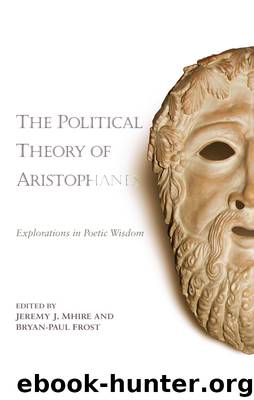
Author:Frost, Bryan-Paul,Mhire, Jeremy J.
Language: eng
Format: epub
Publisher: State University of New York Press
Published: 2014-04-22T04:00:00+00:00
A Divine Comedy: Contesting Divinity
The drama of the Frogs is set in motion by Dionysus’ love of Euripides. Having recently read again Euripides’ Andromeda, Dionysus was struck by the greatness of Euripides’ poetic genius, a genius that none of the remaining Athenian tragic poets even comes close to matching. So Dionysus decides to descend to Hades to steal Euripides away, intending to bring him back to life to revitalize tragic poetry in Athens. Thus imitating in some ways Heracles’ descent into Hades to steal away Cerberus, Dionysus, god of the theater, decides to play the role of Heracles more literally, disguising himself as Heracles. Hilarity then ensues, as we would of course expect of an Aristophanic comedy. The first half of the play especially presents us with the sort of humor in which Aristophanes typically delights. Dionysus’ servant, Xanthias, tries to amuse Dionysus and the audience with original (even if somewhat crude) bodily humor, and we are treated to the comic banter between master and servant. We watch the incredibly effete Dionysus attempting to imitate the incredibly manly Heracles, cutting so ridiculous a figure that Heracles cannot help but simply laugh at the sight of Dionysus when he visits to learn what he can expect to encounter in the underworld. After a comical exchange between the two, and between Dionysus and an unexpectedly reanimated corpse, Dionysus and Xanthias enter the underworld, where the disguised god is not recognized even by those who worship him, a chorus of frogs (with whom he engages in a ridiculous croaking contest), and a chorus of Mystery novices. After a series of costume changes between Xanthias and Dionysus, who is atremble at the thought of being punished for Heracles’ previous misdeeds in Hades, the god, whose identity is now greatly in doubt, is whipped and beaten repeatedly by a lowly servant to test his divinity by seeing if he is superhumanly immune to pain, a test Dionysus manifestly fails and a spectacle that surpasses in both hilarity and impiety even the beating of Strepsiades by his own son Pheidippides in the Clouds.
Aristophanes’ humor, however, is not only funny, but also deeply thought provoking. According to Aristophanes himself, he is concerned not only with presenting us with “many laughable things,” but also with provoking us to think about “many serious things” (Frogs 391–92; cf. Clouds 518–62). Indeed, simply by depicting comically Hades and the gods, Aristophanes prompts us to laugh at and think differently about sacred things we are perhaps not supposed to laugh at or think about in heterodox ways. The very laughter Aristophanes provokes is in itself liberating and thought provoking. Yet Aristophanes does more than merely provoke us to thought; he also guides and directs our thoughts. In the first half of the Frogs, I would suggest that Aristophanes particularly provokes and guides our thoughts to questions about the afterlife, divine justice, and the nature of the gods.
Aristophanes, of course, never denies the existence of Hades or the afterlife. In fact, by presenting
Download
This site does not store any files on its server. We only index and link to content provided by other sites. Please contact the content providers to delete copyright contents if any and email us, we'll remove relevant links or contents immediately.
The Universe of Us by Lang Leav(15076)
The Sun and Her Flowers by Rupi Kaur(14518)
Adultolescence by Gabbie Hanna(8927)
Whiskey Words & a Shovel II by r.h. Sin(8018)
Love Her Wild by Atticus(7758)
Smoke & Mirrors by Michael Faudet(6192)
Wiseguy by Nicholas Pileggi(5786)
The Princess Saves Herself in This One by Amanda Lovelace(4976)
Love & Misadventure by Lang Leav(4848)
Memories by Lang Leav(4800)
Milk and Honey by Rupi Kaur(4748)
Bluets by Maggie Nelson(4556)
Too Much and Not the Mood by Durga Chew-Bose(4348)
Pillow Thoughts by Courtney Peppernell(4284)
Good morning to Goodnight by Eleni Kaur(4234)
The Poetry of Pablo Neruda by Pablo Neruda(4109)
Algedonic by r.h. Sin(4063)
HER II by Pierre Alex Jeanty(3611)
Stuff I've Been Feeling Lately by Alicia Cook(3458)
